Caravan Accessories for Off Grid Camping: 2026 Guide
Table of Contents
- What Off Grid Camping Really Demands From Your Caravan
- Off-Grid Caravan Essentials That Earn Their Space
- Caravan Solar Panels and Batteries: Sizing Your Setup
- Caravan Water Storage and Filtration: How Much Is Enough?
- Accessories That Keep You Safe and Self-Sufficient
- Your Off-Grid Camping Checklist Before You Leave
- Choosing Caravan Accessories That Last
- Frequently Asked Questions
Last Updated: October 12, 2026
What Off Grid Camping Really Demands From Your Caravan
Off grid camping means your caravan has to make its own power, carry its own water and manage its own waste, often for days at a time. That changes what you pack. Plenty of travellers load up on caravan accessories for off grid camping that look impressive in the shop but never solve the actual problem: keeping the fridge cold, the lights on and the tanks empty when there’s no power point for 200 kilometres.
The gap between a powered site and a free camp is bigger than most people expect.
On a powered site, your van behaves like a small house. Off grid, it behaves like a boat. Everything you consume has to be produced, stored or carried, and everything you produce has to be stored until you can dispose of it properly. That single shift should drive every accessory decision you make.
This guide covers what actually earns its place in the van, how to size solar and batteries without overbuying, and the checklist we’d run before any remote trip.
Off-Grid Caravan Essentials That Earn Their Space
Space and payload are your two hardest limits, so the essentials are the ones that keep you self-sufficient rather than the ones that look good in a catalogue.
Weight adds up faster than most people budget for. Every accessory you bolt on or pack in reduces how much water, food and fuel you can carry.
Power, Water and Waste: The Non-Negotiables
Three systems decide whether you’re comfortable or miserable.
- Power: solar panels, a battery bank, a quality regulator and a way to monitor state of charge
- Water: storage tanks plus a filtration setup for refilling from uncertain sources
- Waste: a cassette or portable toilet and a grey water plan for sites that require it
Skip any one of these and your trip shortens, usually on day two.
Kitchen and Comfort Gear Worth Packing
Cooking gear matters more off grid because you can’t duck into town for a meal.
A two-burner stove with a low gas draw, a 12V fridge that’s efficient rather than merely large, and collapsible cookware all pull their weight. Add a decent camp chair, shade and insect protection, and you’ve covered the comfort basics without adding bulk.
Weigh your van loaded, not empty, before your first remote trip. Payload limits catch out more travellers than any other specification, and the scales never lie.
Caravan Solar Panels and Batteries: Sizing Your Setup
The right solar setup matches your daily power use, not the biggest panel that fits on your roof. Work out your consumption first, then size the panels and battery to cover it with a margin for cloudy days.
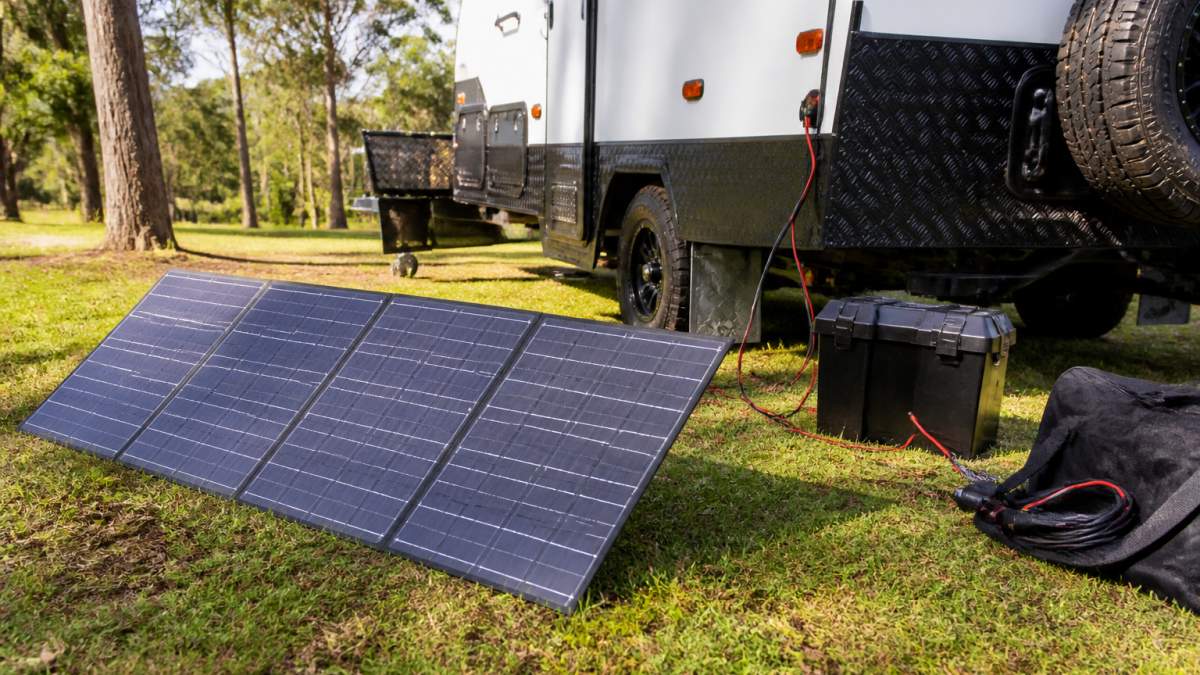
Start by listing what you actually run. Fridge, lights, water pump, phone charging and a laptop are the common load. High-draw appliances like induction cooktops, kettles and air conditioning will drain a modest system quickly, so most off-grid travellers run gas for cooking and heating instead.
Fixed, Portable or Both?
Fixed roof panels charge while you drive and while you’re parked, which makes them the backbone of most setups. Portable panels let you chase the sun when you’re camped under trees, which is exactly when roof panels underperform.
For most travellers, a combination of fixed panels for baseline charging and a portable set for shaded camps handles far more situations than either option alone.
Battery Types and What They Mean for Daily Use
Battery chemistry decides how much usable capacity you actually get.
| Battery Type | Usable Capacity | Weight | Best For |
|---|---|---|---|
| AGM | Roughly half of rated capacity | Heavy | Budget setups, short trips |
| Gel | Similar to AGM, more heat tolerant | Heavy | Hot climates, moderate use |
| Lithium (LiFePO4) | Most of rated capacity | Light | Long trips, heavy daily draw |
Lithium costs more upfront but gives you more usable power per kilogram, which matters when payload is tight. For a weekend van, an AGM bank is often enough. For extended remote travel, lithium usually pays for itself in usable capacity alone.
Caravan Water Storage and Filtration: How Much Is Enough?
Plan for at least five litres per person per day for drinking and cooking, then add washing and cleaning on top. Most off-grid caravans carry between 80 and 120 litres, which covers two people for several days with sensible use.
Filtration matters because you’ll refill from sources you can’t fully trust. A two-stage setup, sediment filter followed by carbon, removes the taste and most of the grit. If you’re refilling from creeks or bores, add a proper inline filter and treat the water before drinking.
Carry a spare filter cartridge. They clog at the worst possible moment, usually mid-trip.
Never assume a tank is clean because it looks clean. Untreated water sitting in a tank in warm weather grows bacteria quickly, and the illness that follows will end your trip faster than any mechanical failure.
Accessories That Keep You Safe and Self-Sufficient
Safety gear is where off-grid camping separates the prepared from the lucky. The good news is that most of it is compact and inexpensive.
Communications come first. Mobile coverage disappears quickly once you leave the main routes, so a satellite messenger or personal locator beacon belongs in every remote van. Recovery gear, a first aid kit and a fire extinguisher round out the basics.
Then there’s the quiet category most people forget: tools and spares. A basic toolkit, fuses, hose clamps and a tyre repair kit solve the majority of roadside problems without a call-out.
- Satellite messenger or personal locator beacon
- Recovery tracks, snatch strap and rated shackles
- First aid kit and fire extinguisher
- Basic toolkit, spare fuses and hose clamps
- Tyre repair kit and a working jack
Your Off-Grid Camping Checklist Before You Leave
Run this checklist the week before departure, not the morning of.
- Test solar charging and confirm battery holds charge under load
- Fill water tanks and check every tap and fitting for leaks
- Empty and service the toilet cassette
- Confirm gas bottles are full and connections are leak-free
- Charge satellite messenger and register your trip plan
- Check tyre pressures and torque wheel nuts
- Weigh the van loaded and confirm it’s within payload
- Pack spare filters, fuses and a basic toolkit
Two hours of preparation prevents most of the problems that ruin remote trips.
Choosing Caravan Accessories That Last
Durability comes down to three things: materials, repairability and whether the manufacturer actually supports the product after sale.
Stainless steel and UV-stable plastics survive the conditions. Anything with moving parts should have serviceable components, because a pump or regulator you can rebuild beats one you have to replace. And a brand that answers questions and honours warranties is worth more than a slightly cheaper alternative that disappears after the sale.
As an Australian family business, we aim to stock products that last.
Buy for the trip after this one. Accessories that survive a single season rarely survive three, and replacing cheap gear repeatedly costs more than buying properly once.
Frequently Asked Questions
What accessories do you need for off-grid caravan camping?
Start with the systems that keep you running: solar panels and a battery bank, a water tank with filtration, a portable toilet or cassette system, and a fridge that runs on 12V. Add a gas cooker, LED lighting, and a first aid kit. The exact list depends on how long you plan to stay off grid and whether you’ll have any power hookup along the way. Build your caravan accessories around power and water first, then layer in comfort items.
How much water should you carry for off-grid caravan camping?
Budget around 10 to 15 litres per person per day if you’re cooking, washing up and showering sparingly. A couple travelling for four days would need roughly 80 to 120 litres, so a 100-litre tank plus a few jerry cans covers most trips. Carry a separate drinking water container and a filtration setup so you can top up from trusted sources without worrying about taste or sediment.
Do you need solar panels for off-grid caravan camping?
If you’re running a 12V fridge, lights, and device charging, solar is the most practical way to keep batteries topped up without a generator. A 200W to 400W setup suits most couples, depending on fridge size and how much sun you get. Pair panels with a lithium or AGM battery bank and a quality regulator. For heavy power use or cloudy stretches, a DC-DC charger from your vehicle adds backup.
What should you check before buying off-grid caravan accessories?
Match every accessory to your caravan’s existing wiring, tank capacity and payload limits. Check that solar regulators and chargers are compatible with your battery chemistry, and confirm the physical dimensions fit your storage spaces. Look for gear rated for Australian conditions, with clear warranty terms and spare parts available. Buying from a supplier with fast delivery and straightforward returns makes it easier to fix mistakes before your trip.
Off-grid travel rewards preparation and punishes shortcuts, and the gear you choose decides which one you get. Wide Bay Products stocks a carefully selected range of camping and caravan accessories, backed by free delivery on most orders Australia wide and friendly local service from our Queensland team. Browse the range, add to cart, and kit out your van for the trips that actually matter.