Essential Caravan Accessories for Australian Travel
Table of Contents
- Caravan Essentials Checklist: What You Actually Need Before You Tow
- Caravan Safety Equipment: What the Law Requires and What Keeps You Safe
- Caravan Storage and Organisation Ideas That Save Space and Sanity
- Caravan Accessories for Long Trips: Comfort, Power, and Water
- Essential Caravan Accessories for Australian Travel: Climate and Route Planning
- Weight, Storage, and Payload: The Trade-Offs Nobody Talks About
- What to Ignore: Accessories That Waste Money and Space
- Conclusion: Prioritising Your Caravan Setup
- Frequently Asked Questions
Last Updated: October 9, 2026
Caravan Essentials Checklist: What You Actually Need Before You Tow
Packing for a caravan trip is not about filling every cupboard. This caravan essentials checklist from Wide Bay Products covers the items that earn their place, and the ones that just add weight.
A good set of caravan accessories does three jobs: it gets you set up fast, keeps you safe on the road, and makes camp life comfortable.
Towing and Setup Gear You Cannot Leave Home Without
Towing gear is where safety and convenience meet. Skip it and your first setup will take an hour longer than it should.
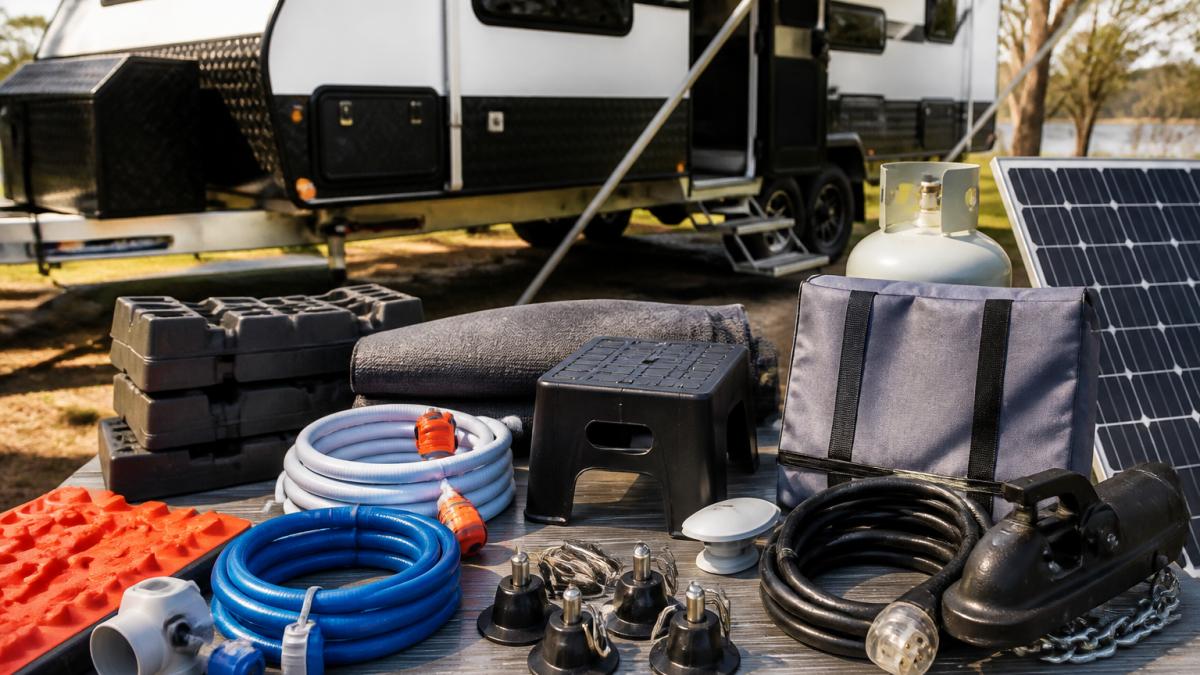
- Levelling ramps and a spirit level to get the van flat
- Wheel chocks so it cannot roll once unhitched
- Towing mirrors for a clear view down both sides
A common mistake is buying ramps that are too short for your wheel size. Check the ramp rating against your van’s weight before you buy.
Comfort and Living Essentials for the Campsite
Comfort gear is what turns a caravan into a home. It also adds the most weight, so choose carefully.
- A mattress topper to soften a firm factory mattress
- Privacy shade for the awning on hot afternoons
- A caravan floor mat or turf mat to keep sand and dirt outside
The floor mat is the one people forget. A good one keeps your van cleaner and cuts your cleaning time at every stop.
Caravan Safety Equipment: What the Law Requires and What Keeps You Safe
Safety gear splits into two groups: what you must carry, and what you should carry. The National Heavy Vehicle Regulator guidance sets out many of the towing and load rules that apply across borders, and each state road authority publishes its own list of required equipment.
Must-carry items usually include:
- A first aid kit stocked for remote travel
- Warning triangles or a reflective sign
- A fire extinguisher rated for your van
Then there is the gear that keeps you safe when something goes wrong. A tyre repair kit, an electrical tester, and a basic tool kit with a cordless drill will get you out of most roadside trouble.
The Legal Layer Most Guides Skip
Beyond the physical kit, three legal requirements catch caravanners out more than any other:
- Towing visibility. Towing mirrors must give you a clear view down both sides of the van. If your standard mirrors do not, extended mirrors are not optional, they are a compliance item. Police can and do issue infringements for inadequate rear vision.
- Weight and load limits. Every van has a tare mass, an aggregate trailer mass (ATM), and a ball weight. Exceeding any of them is an offence and voids most insurance claims. The Australian Competition and Consumer Commission product safety guidance is a useful starting point for understanding your obligations as a buyer and user of towing equipment, and your van’s compliance plate lists the figures that apply to you.
- Electrical safety. Any 240V work inside a caravan should be done by a licensed electrician and tested before each trip. A residual current device (RCD) on the van’s inlet is standard on newer vans but missing on many older ones, check yours.
Pre-Departure Checks Worth Doing Every Time
A five-minute walk-around before you tow prevents most breakdowns:
- Tyre pressures, cold. Check the van and the tow vehicle, including the spare. Under-inflation is the leading cause of caravan tyre failures.
- Wheel nuts. Re-torque them to the manufacturer’s setting before every trip and again after the first 100km of a long run.
- Coupling and safety chain. Confirm the hitch is locked down and the chain is crossed correctly.
- Lights. Indicators, brake lights, and clearance lights, get someone to walk behind while you test them.
- Breakaway system. If your van has one, confirm the battery is charged and the pin is seated.
Never tow without checking your tyre pressures cold and your wheel nuts at every stop. A loose wheel nut is one of the most common causes of caravan breakdowns, and it is completely preventable.
What to Carry for Remote Travel
Once you leave the sealed roads, the safety list grows. Most experienced remote travellers add:
- A second spare wheel or at least a spare tyre carcass
- A tyre pressure gauge and a 12V compressor
- Extra water, a minimum of 5 litres per person per day as a reserve
The rule of thumb: if a failure would leave you stranded more than a day from help, carry the tool or spare that fixes it.
Caravan Storage and Organisation Ideas That Save Space and Sanity
Storage is about access, not volume. A van packed to the roof is harder to use than one with clear zones.
Group gear by how often you use it.
- Daily items near the door: chairs, mat, kettle
- Weekly items in mid cupboards: tools, spare bedding
- Emergency items in one labelled box: first aid, fuses, torch
Stackable crates and clear containers beat built-in cupboards for flexibility. Label everything. You will thank yourself at 9pm when you are hunting for the can opener.
Caravan Accessories for Long Trips: Comfort, Power, and Water
Long trips change your priorities. Power and water move to the top of the list, because you will be off-grid more often. But the right gear depends entirely on how you plan to camp, and that is the part most accessory lists skip.
Match Your Power Setup to Your Camping Style
There is no single “best” power setup. There are three common patterns, and each needs different gear:
- Powered sites only. You plug into a caravan park outlet every night. You need a power extension cord rated for outdoor use, a set of electrical adaptors for different park outlets, and a surge protector to guard against dodgy park wiring. A portable power station is optional here, useful for a night or two off-grid, but not essential.
- Mostly powered, occasional free camps. Add a portable power station sized to run your fridge and lights for one to two nights, plus a solar blanket to top it up during the day. This is the most common setup for couples doing a mix of parks and roadside stops.
- Off-grid and remote. You need a proper solar panel array matched to your battery bank, a DC-DC charger to charge from the tow vehicle while driving, and enough battery capacity to run your fridge through cloudy days. Size the system around your fridge first, it is the biggest draw by far.
A common mistake is buying a portable power station that looks impressive on paper but cannot actually run a compressor fridge overnight. Check the usable watt-hours, not the peak output.
Water: Storage, Filtration, and the Reality of Remote Top-Ups
Water planning is where long trips succeed or fail. A portable water tank and a water filter let you top up from more sources, but the type of filter matters:
- Carbon filters improve taste and remove chlorine, fine for town water.
- Microbiological filters (often called “gravity” or “pump” filters) remove bacteria and are the minimum for creek or bore water.
- Reverse osmosis is overkill for most travellers and wastes water in the process.
Carry toilet chemicals too, and keep your sanitation routine simple. A blocked or smelly toilet will ruin a trip faster than bad weather. If you are free camping for more than a few days, a portable toilet and a privacy tent give you options when the nearest dump point is hours away.
Freeze a few water bottles before you leave and use them in your esky first. They double as ice and drinking water, and they save space you would otherwise waste on loose ice.
Comfort Gear That Earns Its Place on Long Trips
Comfort items add weight, so on long trips they need to justify themselves. The ones that consistently do:
- A mattress topper, factory caravan mattresses are firm, and a topper is cheaper than replacing the mattress.
- Privacy shade for the awning, essential in summer, and it doubles as a windbreak.
- Insect screens, non-negotiable in the tropics and along inland rivers.
What to leave behind: bulky outdoor furniture, multiple cooking appliances, and anything you have not used on your last two trips. Long trips punish excess weight more than short ones do.
Essential Caravan Accessories for Australian Travel: Climate and Route Planning
Climate and route decide your packing list. A coastal run needs different gear to a desert crossing.
Coastal and tropical trips mean humidity, salt, and insects. Pack extra privacy shade, insect screens, and a caravan cover for storage between trips.
| Trip Type | Priority Gear | Why It Matters |
|---|---|---|
| Coastal and tropical | Privacy shade, insect screens, caravan cover | Handles humidity, salt, and bugs |
| Inland and desert | Extra water, water filter, offline navigation | Long gaps between supplies |
| Alpine and cold | Extra bedding, gas check, insulation | Cold nights and higher gas use |
The Bureau of Meteorology outlook is worth checking before any long run, so you pack for the weather you will actually meet.
Weight, Storage, and Payload: The Trade-Offs Nobody Talks About
Every accessory adds weight, and every van has a payload limit. This is the part most guides skip.
Payload is the total weight you can add to the van, including water, gas, gear, and food.
- Weigh your van empty before you load it
- Add water and gas, then weigh again
- Keep a running list of gear weights
The Australian Competition and Consumer Commission product safety guidance is a useful starting point for understanding your obligations as a buyer and user of towing equipment.
If you are near your limit, choose gear that does two jobs. A turf mat that doubles as a shade wall saves weight and space.
What to Ignore: Accessories That Waste Money and Space
Not every accessory earns its place. Some are sold on fear, others on novelty.
Skip anything that:
- Duplicates a tool you already carry
- Only works in one very specific situation
- Adds weight without solving a real problem
The rule we use is simple. If you have not needed it in three trips, leave it home. You can always buy it later if the need shows up.
Conclusion: Prioritising Your Caravan Setup
Building a caravan setup is a process, not a single shopping trip. Start with safety and towing gear, add comfort and storage, then build out power and water for the trips you actually take.
We stock a carefully selected range of camping and caravan essentials, backed by fast Australia-wide delivery and free shipping on most orders.
Get started and build a caravan setup that works for every trip you take.
Frequently Asked Questions
What accessories do you need for a caravan?
Start with safety and setup gear: towing mirrors, a weight distribution hitch, levelling ramps, wheel chocks, and a spare tyre. Add a power extension cord, water hose, and a basic tool kit. For comfort, pack a caravan floor mat, outdoor chairs, bedding, and kitchen essentials. A caravan essentials checklist should cover towing, safety, power, water, comfort, and repairs. Prioritise items you will use every trip over single-use gadgets that add weight without earning their place.
What safety equipment should you carry in a caravan?
Carry a fire extinguisher, smoke alarm, first aid kit, and a tyre pressure gauge. Towing mirrors are a legal requirement in most states when your caravan is wider than your vehicle. A breakaway system and safety chains must be fitted and checked before every trip. Pack high-visibility markers, a warning triangle, and a torch. Check your state’s road authority for specific requirements, as towing regulations vary across jurisdictions and your caravan’s weight and dimensions determine what applies.
How do you make a caravan more comfortable for long trips?
Focus on sleep, seating, and climate. A quality mattress topper transforms the caravan bed, and breathable bedding keeps you cool in warmer months. Add a privacy shade to your awning for extra living space and sun protection. A turf mat or caravan floor mat keeps sand and dirt outside. For power, a portable power station or extra extension cord keeps devices charged. Small touches like storage baskets, a door mat, and a comfortable outdoor chair make the biggest difference over weeks on the road.
What tools and spares should you keep in a caravan?
Pack a socket wrench set, cordless drill, electrical tester, tyre repair kit, and lubricants for hinges and couplings. Spare fuses, globes, and a roll of duct tape handle most roadside repairs. A basic first aid kit and a fire extinguisher are non-negotiable. Keep your tool kit in an accessible spot, not buried under bedding. Check your spares before each long trip, as vibration and temperature changes can loosen fittings and drain batteries.